Showing posts with label infographic. Show all posts

Thursday, March 5, 2015

A Beautiful Visual Explanation of Hashtags

March 6, 2015
Hashtags are social networking phenomena par excellence. They originated in Twitter a around 2008 and since then they adopted and integrated into many other popular social platforms such as Facebook, Google Plus, and Instagram. We have already shared several posts covering the educational potential of hashtags, most popular among them all is teachers� simple guide on the use of hashtags.

Today we are sharing with you this beautiful visual  we discovered through a tweet from Tom D�Amico. This visual, which is created by Quick Sprout and initially shared on The Seen, provides a very good explanation of what the concept of hashtaging is all about and how it works in different social media websites such as Instagram, Twitter, Facebook and Google Plus. We invite you to have a look and as always share with us what you think of this work.

Ultimate Guide on Hashtag

Thursday, February 26, 2015

A Beautiful Classroom Poster On Steps for Good Writing

February 27, 2015
5 Steps to Writing A Poem is a visual created by  Cambridge University and outlines the 5 major stages to composing a poem. In fact, the steps mentioned here are generic and can be used for writing any other genre, of course with a bit of tweaking. As a teacher you might want to share this work with your students and guide them through the different stages they need to follow to produce a good piece of prose or poetry.

The 5 steps featured in this visual are : inspiration (some basic techniques for generating inspiration and ideas to write about), Brainstorm (mapping out ideas), Form and Style (raise students consciousness to the different styles out there), Word Choice (use of language and vocabulary), Five Sense (engage your senses to create and imagine scenarios for your ideas and writing).


The visual is available in PDF format that you can download for free and use with your students. Here is the download link. Click HERE to see and download the original poster.

Tuesday, February 24, 2015

A Beautiful Visual Featuring The 7 Cs of Effective Communication

February 24, 2015
Following the post we shared here a few weeks ago featuring some useful resources to help teachers and educators master the art of presenting, somebody sent us this beautiful visual which ties in with the theme of that post. 7 Cs of Effective Communication is a work from Brainy Quote and Evan Carmichael. The visual  outlines some interesting strategies to keep in mind when delivering a talk, facing an audience, or conversing with others. Communicative competence is at the core of the skills we need as teachers and it is also the key to a better mutual understanding. We are hoping the visual will provide you with a refresher on some of the effective ways to maintain effective communication. Have a look and share with us what you think of this work.


communication tips

Monday, February 23, 2015

27 Reflection Strategies to Improve Your Teaching

February 23, 2015
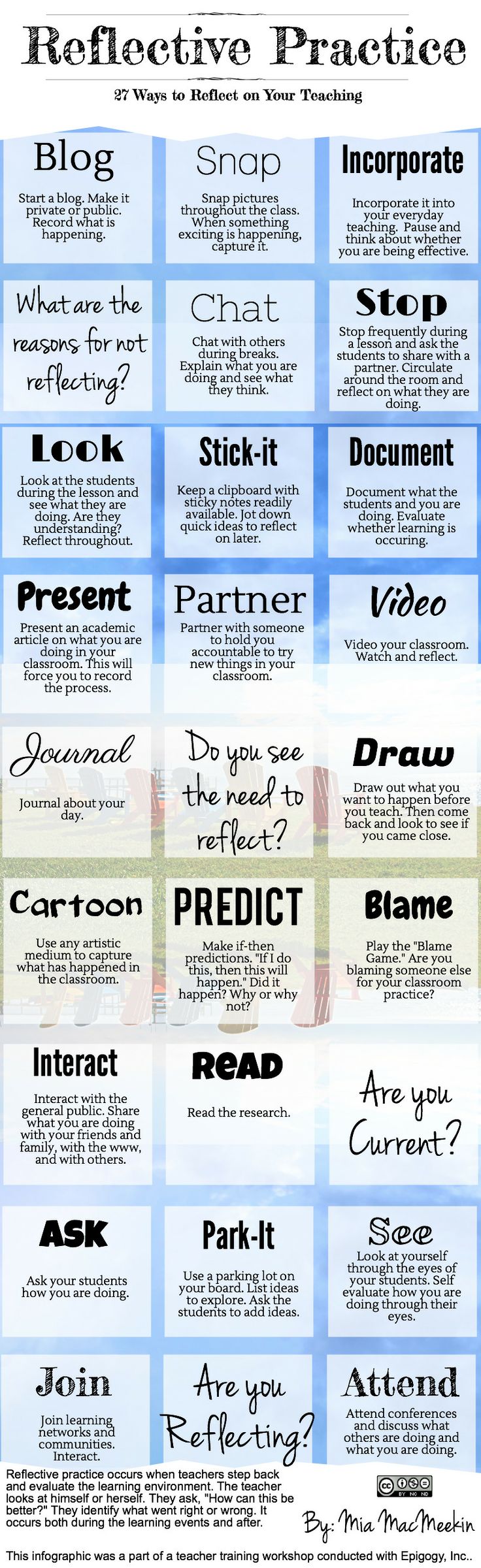
Reflection and reflexivity are two meta-cognitive processes that we constantly need to exercise in order to guarantee an effective and healthy professional and also emotional growth. Unless you take a pause and think deeply about what you are doing and how you are doing it, you will never get to learn about your weaknesses and strengths. You won�t be able to stop navel-gazing and see the whole picture from an onlooker perspective.

As a teacher, there are several ways and strategies to employ to cultivate a reflective mindset and enhance your self-evaluative practices. Some of these strategies are beautifully captured in the visual below created by Mia MacMeekin from Anethicalisland. We invite you to go through them and share with us what you think of this work. Enjoy

27 Ways to Reflect on Your Teaching  Follow us on : Twitter, Facebook , Google plus, Pinterest .

Tuesday, February 17, 2015

The 7 Attributes of Successful People

January 17, 2015
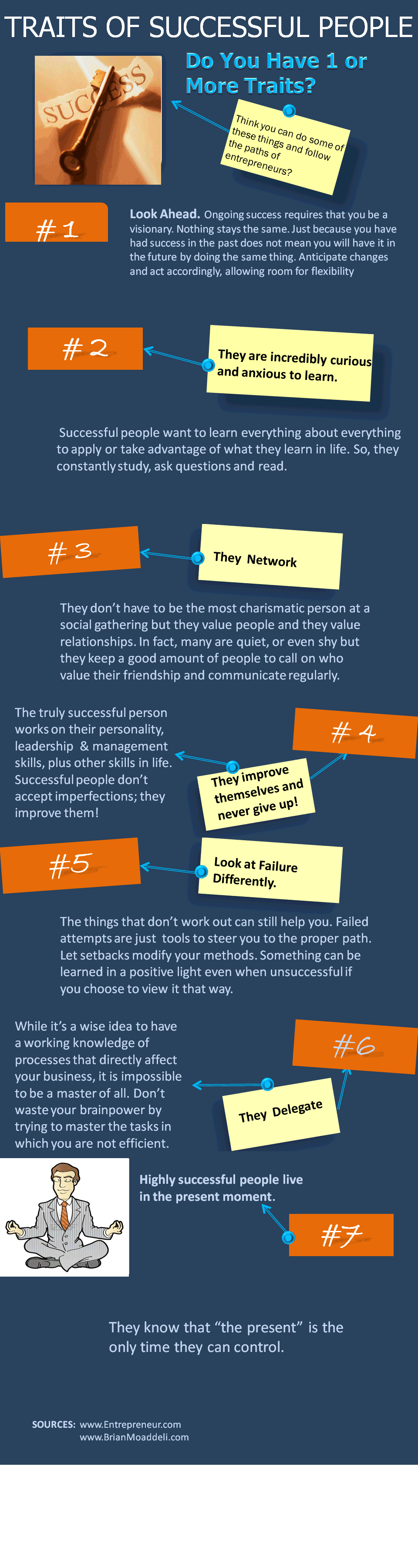
Traits of Successful People is an interesting visual that delves deep into the  mindset of those who have embraced success in their lives. Setting aside the definitional problematic of success (for success can mean different things to different people) we can all probably convene on the idea that successful individuals do have many things in common at least on the conceptual level. For instance, successful people tend to have an open aptitude towards mistakes and view them as precursors of good learning. And while they live in the present, successful people always anticipate and prepare for the future. They are flexible enough to adapt to change and are willing to constantly learn from others. These and several other traits make up the mindset of successful people as shown in the graphic below.


Traits of Successful People
Via : Loveinfographics 
Follow us on : Twitter, Facebook , Google plus, Pinterest .

5 Effective Ways for Developing Problem Solving Skills

February 17, 2015
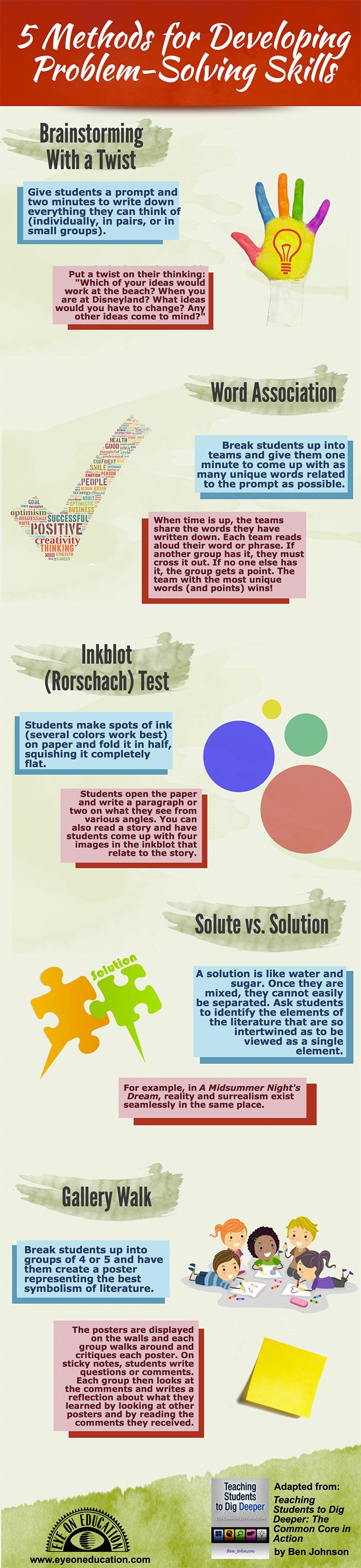
Here is a wonderful visual from Eye on Education featuring 5 methods for developing problem-solving skills. This work is adapted from Ben Johnson�s book � Teaching Students to Dig Deeper; The Common Core in Action�. The methods advocated here include: brainstorming, word association, Inkblot test, solute vs solution, gallery walk. Each of these methods is explained and illustrated with examples on how to use it with your students. I invite you to check it out and share with us what you think of it . Enjoy

Problem solving strategies

Monday, February 16, 2015

A Beautiful Timeline On The Evolution of Learning Technologies

February 16, 2015
"Human beings have always been seekers of knowledge. The minute we discover something new, we want to share it with others and move onto the next achievement. Since the beginning of recorded history (and probably before) we have always strived to discover the mysteries of the planet, of Earth and of ourselves. How has learning evolved over the course of human history and what might the future hold for us?"


Check out the visual below to learn more

evolution of learning technologies  Source Open Colleges
 Courtesy of eLearning Infographics

 Follow us on : Twitter, Facebook , Google plus, Pinterest .

Monday, February 9, 2015

New Poster- 15 Useful Tips to Help Students Overcome Procrastination

February 10, 2015
If anything, digitally has taken procrastination to unprecedented levels. Keeping focused and on task in a world where multiple sources of distraction are at work competing for ones� attention is really a challenging endeavour. And when it comes to students and digital natives the case is even worse. I sometimes think that we, digital immigrants, are really lucky to have studied in an era where the hype of Internet and social media was non existent. However, procrastination does not have a sole cause and digital preoccupation is  only one factor among many that lead to this state of inaction.


The visual below features 15 interesting and scientifically-backed strategies that students can use to beat procrastination. I want you to check them out and share them with your students. Here is a brief round-up of these strategies.
  • Know yourself
  • Practice Effective Time Management
  •  Change Your Perspective
  • Commit to Assignments
  • Work in Productive Environments
  • Be Realistic
  • Self-Talk Positively
  • Un-Schedule
  • Swiss-Cheese Tasks
  • Don�t Indulge Fantasies
  • Plan for Obstacles
  • Improve Learning Behavior
  • Help Yourself
  • Reward Progress
  • Learn to Forgive Yourself
15 Tips to Beat Procrastination
Source: Essay Expert
Courtesy of : eLearning Infographics

Saturday, February 7, 2015

This Is Why Handwriting Helps Students Learn Better

February 8, 2015
In "what does your handwriting say about you" we learned that the way we write can reveal  great deal  about our personalities. For instance, the people who use small letters are said to be shy, withdrawn, or meticulous while those who tend to opt for moderate letters are well-adjusted and adaptable. Using wide spacing, on the other hand, indicates a person who enjoys freedom and doesn't like to be overwhelmed or crowded. The shape of letters can also tell something about your personality traits. For example, using rounded letters shows that one is creative and artistic; pointed letters are indicative of aggressive and intense behaviour.


In today's post, I am introducing you to another equally important infographic but this time on the importance of handwriting for enhancing  learning. The visual features some really interesting facts about the impact of handwriting on our cognition. It also provides some useful tips to help students improve their handwriting. I invite you to have a look and share with us what you think of it. Enjoy

The Impact of Handwriting on Learning
Source : Giraffe
Courtesy of Learning Infographics

Follow us on : Twitter, Facebook , Google plus, Pinterest .

Tuesday, February 3, 2015

A Wonderful Poster on The Benefits of Reading

February 4,  2015
Today I am sharing with you this wonderful infographic on the benefits of reading created by Raphael Lysander. You can use this document with your students in classroom to raise their awareness to some important facts about reading. For instance, did you know that a 6 minutes of reading can reduce stress by 60%? How about the fact that reading reduces stress more than listening to music by 685, walking by 300%, and playing video games by 700%?

Yes , these and several other facts included in the visual below are really mind-blowing and the important thing about this work is that it is backed up by references to books, articles and scientific studies. This infographic is also available in premium format that is Print friendly from this link. I invite you to check it out and share with your colleagues. Enjoy

(N.B: small typo in the title: benefits not benifites)

Benefits of reading  Follow us on : Twitter, Facebook , Google plus, Pinterest .

Monday, January 26, 2015

This Is Why Students Need to Learn Coding

January, 2015
Coding is becoming one of the essential literacies in the 21st century education. There is a growing demand now for teaching students how to code. In his wonderful TED talk titled "Let's teach kids to code", Scientist Mitch Resnick made this beautiful analogy :


When kids learn to code , it enables them to learn many other things, opens up many new opportunities for learning. It's useful to make an analogy to reading and writing, when you learn to read and write it opens up opportunities for you to learn so many other things, when you learn to read you can then read to learn, which is the same thing with coding, if you learn to code you can code to learn. 

To further highlight the importance of teaching kids coding skills, I am sharing with you this beautiful visual titled" Rise of Coding". The visual features some interesting facts and information on  why coding is essential in our digital era.

Why we should teach kids coding
Source: Online College.  Courtesy of : elearning infographics


 Follow us on : Twitter, Facebook , Google plus, Pinterest .

Saturday, January 24, 2015

10 Important Skills for Active Listening

January, 2015
Listening is an important skill that, unfortunately, is not given its due worth in school curricula. Listening is the key to understanding, a better understanding. It is a way of communicating and appreciating the world around us. The kind of listening am talking about here is what sound expert Julian Treasure called conscious listening. This is a mental process that consciously receives and decode auditory input. Stephen Covey talks about empathic listening (from empathy) and listed it as the fifth habit of highly effective  people. Empathic listening according to Stephen is an entirely different kind of listening; 'it is listening with the intent to understand, to really understand'. He added "empathic listening gets inside another person's frame of reference. You look out through it, you see the world the way they see the world, you understand their paradigm, you understand how they feel." (p. 251 in The 7 Habits of Highly Effective People).

Given the important of active listening as an integral learning skill, here is a very good chart featuring some  handy listening activities and skills you can share with your students. This chart which I learned through this EdTech board is based on the work of  Storytelling and User Experience.

Check out an enlarged format of this chart from this link.


 Follow us on : Twitter, Facebook , Google plus, Pinterest .

Wednesday, January 21, 2015

Personalized Learning Vs Traditional Learning

January 22, 2015
One of the biggest affordances of technology is towards the enhancement of the concept of personalized learning. Internet and more particularly web 2.0 technologies and mobile apps have provided learners with unprecedented opportunities to learn whenever, wherever, and however they want. At its core, personalized learning is all about tailoring the available resources in order to meet personal learning needs. On a macro educational scale, personalized learning addresses different teaching strategies and instructional methods that focus on the adjustment and leverage of the curricula and teaching materials to help meet a diverse set of students learning needs and interests.

The visual I am sharing with you today sheds more light on this concept and walks you through some of the differences between personalized learning and traditional learning. Check it out below and share with us what you think of it.


personalized learning vs traditional learning  Source: Dreambox

Monday, January 19, 2015

A Good Visual Timeline On The History of Hashtag

January 20, 2015
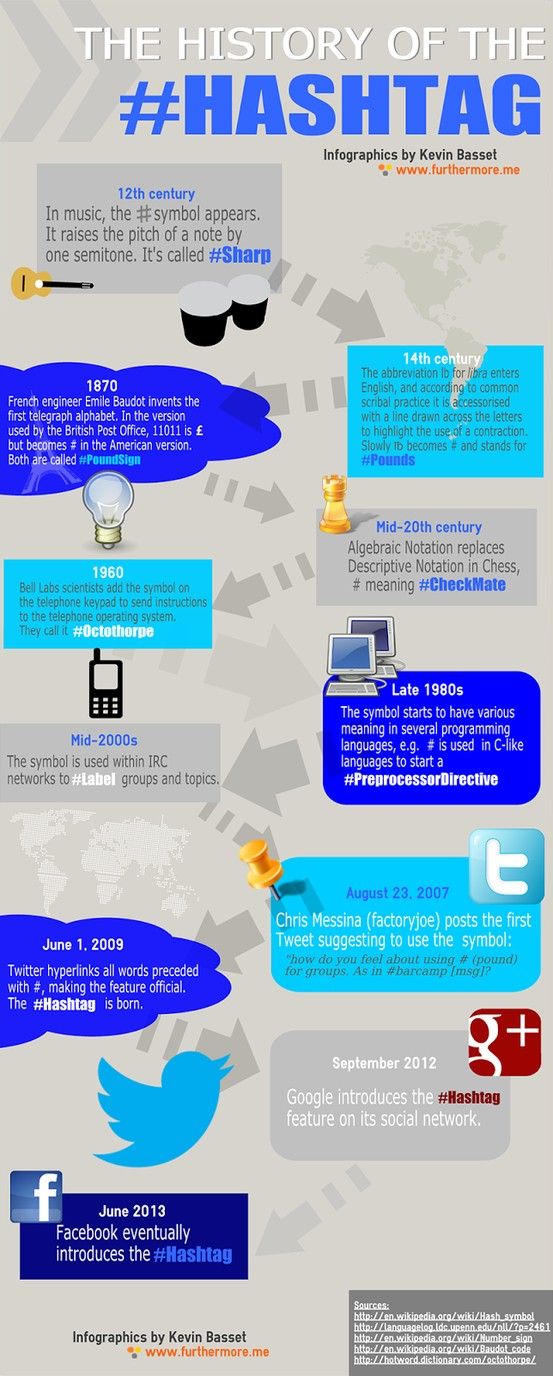
This little digital creature called Hashtag has been revolutionizing the way people network, communicate and share on social media websites. It first started on Twitter around the year 2009 then Google Plus adopted it in 2012 before Facebook officially integrated it in June 2013. However, what is mysteriously unknown about this #poundsign is that its origin dates back to the 12th century when the #symbol first appeared in the musical realm. Since then, hashtags have been used in different contexts and for different purposes till they finally landed in the social media landscape some few years ago. The visual below provides a very good visual illustration of the chronological development of the sign #hashtag.

I came across this visual on ICTphms social media board on Pinterest. The board also features a plethora of other interesting visuals on everything related to social media.

  The history of hashtag
Source of the visual: http://www.furthermore.me/

A Beautiful Visual On The impact of Social Media on Students

January 20, 2015
There is a growing debate inside educational circles on the impact of social media on students learning. Studies are divided between those that empirically attest to the importance of including these web tools in learning and others that view them as mere waste of time and detrimental to students overall cognitive and attentional capacities. Apparently there is no solid convergence on a common decision on this topic. The visual below, which I learned from Mr. Kirsch's Blog,  beautifully captures the different takes on the  use of social media by students.Check it out to learn more.


Impact of social media on students
Source: Onlineeducation.net

Sunday, January 18, 2015

Awesome Visual Featuring The 6 Types of Technology Integrators

January 18, 2015
Here is an interesting visual that has been making rounds online.The Pencil Metaphor outlines 6 types of how people react to technology. This work reminds me of Rogers theory of Diffusion of Innovation which I covered in a post I published two years ago. Rogers classified people into 5 categories based on their propensity to adopt a specific innovation. These are: Innovators, early adopters, early majority, late majority, and laggards.

Similarly, the Pencil Metaphor draws on how people respond to technology to classify them into six categories:


�1. The Hangers-On
Hangers-on know all the right lingo, attend all the right seminars, but just don�t do anything.

2. The Erasers
These people endeavour to undo much, if not all, of the work done by the leaders.

3. The Ferrules
These people hang on tightly to what they know. They keep a strong grip on their traditional practices, and feel that there is not a place for technology in their classroom.

4. The Wood
These people would (get it?) technology if someone would just get them the gear, set it up, train them, and keep it running. All they need is help from some sharp person, and they would be doing it too.

5. The Sharp Ones
These are the people that see what the early adopters have done, willingly grab the best of it, learn from the mistakes of others, and do great stuff with their students.

6. The Leaders
These people are the first to take on the technology, the early adopters would usually document and enthusiastically share what they have tried, warts and all.�

The origin of this visual is debatable. Teachthought, where I initially learned about this graphic, cites a few sources where this work has been previously featured. These sources include:


Wednesday, January 14, 2015

A Handful of Good Sketches Illustrating Education Predictions for 2015

January 14, 2015
The Twitter hashtag #EdPredections has been making the news lately creating a growing discussion among educators around predictions of the major events that will mark education in the year 2015. Two interesting resources I stumbled upon via this hashtags and which I really liked are �Kindergarten Entry Test and More Education Predictions for 2014� and �Sketchucation�. Both of these articles are shared by nprEd.

Source: nprEd
In the first article, the nprEd team featured 15 provocative predictions of what they think will characterize education in this year. Top of these predictions is the integration of blended learning as a daily practice followed by more scrutiny of student data. The article is really a good read and delves deep into more details on each of these predictions. Sketchucation is kinda funny. The word probably refers to an amalgamation of sketching and education. This article features some awesome sketches created by LA Johnson illustrating in a comic way some of the predictions shared through the #EdPredictions hashtag. I invite you to check them out and share with your colleagues.

 Follow us on : Twitter, Facebook , Google plus, Pinterest .

Tuesday, January 13, 2015

Anatomy of Successful 21st Century Student

January 14, 2015
Often times when we hear the phrase �21st century� prefixed to the noun student our thinking goes straight to technology and digital media. We make technology a pivot around which revolves learning when in fact technology is only a means to an end. Equating 21st century education with digital know-how per se is a blatant fallacy.

Learning is primarily a situated social and cognitive process that feeds on different competencies part of which is digital savviness. There are, however, other important parts that make learning a successful and enjoyable endeavour. These parts relate to the personality of the learners and their daily habits. Devry University has this excellent visual that sheds some light on these personal features that make up today�s successful learners. I invite you to check them out and share with us what you think of them.


anatomy of 21st century learners
Courtesy of elearning infographics
 Follow us on : Twitter, Facebook , Google plus, Pinterest .

Thursday, January 8, 2015

A Beautiful Visual on Reading Tips to Use with Students

January 8, 2015
Here is a very good read shared by Edutopia on their Facebook page.�5 Tips for Helping A Student Read� is an article written by Rebecca Alber in which she shared some interesting insights on how  to get your students to love reading by helping them make the best of their reading choices. Next time you want to assign a reading task to your students, keep in mind and reflect on the following:What do you know about your kids� reading interests and likes? Assess past reading experiences of your students and identify what worked and what did not work.

The visual below created by @Worldlib sums up the 5 reading tips to help students find good books. You can also read the full article with more details on each of these tips from this Link.

Source of the visual: http://goo.gl/3Dj0Lv


Monday, January 5, 2015

A Very Good Visual on Inspirational Leaders

January 6, 2015
Leadership comes with hard work but successful leadership entails more than just laboriousness, it calls for special traits that only a select few possess. Whether these traits are skills that can be developed or are a matter of biological endowment is something which still needs scientific back-up. Generally speaking, successful leaders do have something in common. They share a set of common characteristics such as : confidence, focus, trust, far-sightedness, accountability, enthusiasm, persistence, communication, determination, love of their work, and patience.


Also, successful leaders are a joy to be around. They listen empathically and are a source of inspiration and zeal to the people around them. Now that you are reading these lines, you might probably  be calling to your memory somebody who has inspired you directly or indirectly; well, these are the  people we call real leaders. A great read in this direction which I highly recommend for anyone interested in this topic is Eric Sheninger 's recent book entitled " Digital Leadership: Changing Paradigms for Changing Times".

I am also sharing with you this interesting visual I learned from a tweet by Eric Sheninger. The visual, which is created by Business Management Degrees and shared on Enterpreneur, features the different types of leaders and some of the distinctive qualities that set inspirational leaders from the rest. I invite you to have a look and share with us what you think of it. Enjoy