Showing posts with label educational posters. Show all posts

Wednesday, December 31, 2014

Wonderful Mini-posters on The 21st century Literacies

December 31, 2014
The concept of literacy is notoriously elusive and hard to define. Aside from the shallow and intellectually-impaired  definition that sums up  literacy in  reading and writing printed text, any serious and profound investigation of literacy does, by implication, entail an analysis of the new ways of learning and meaning-making afforded by digitality. New digital media have provided learners with novel and revolutionary ways of producing, discussing, sharing and interacting with text.

These ways, to say the least about them, are multimodally complex and call for an integrated set of skills that go beyond the mere ability to code and decode meaning. In this sense, to be literate in such a multimodal environment requires understanding and using a wide range of interconnected literacies. We are no longer talking about a single literacy as was the case since the invention of writing some 6000 year ago, we are, instead,  in front of multiple new emerging  and interdependent literacies. Today's students are asked to have a working knowledge of these literacies in order to be able to thrive in a globalized knowledge economy. Katchy Schrock has this wonderful resource where she features some awesome mini-posters defining the key literacies making up today's Literacy (with capital letter) landscape.  These visuals are ideal for classroom inclusion. I invite you to check them out and share with your colleagues.

Here is a quick round-up of the major literacies included in these posters:

  • Information literacy
  • Visual literacy
  • Critical literacy
  • Media literacy
  • Tool literacy
  • Digital literacy
  • Data literacy
  • Global literacy
  • Economic literacy
  • Civic literacy
  • Health literacy
  • Historical literacy
  • Traditional literacy

Here is an  example of Kathy's posters. Check out the rest of these posters from this link.


Tuesday, November 11, 2014

6 Questions Every Critical Thinker Should Ask

November 11, 2014
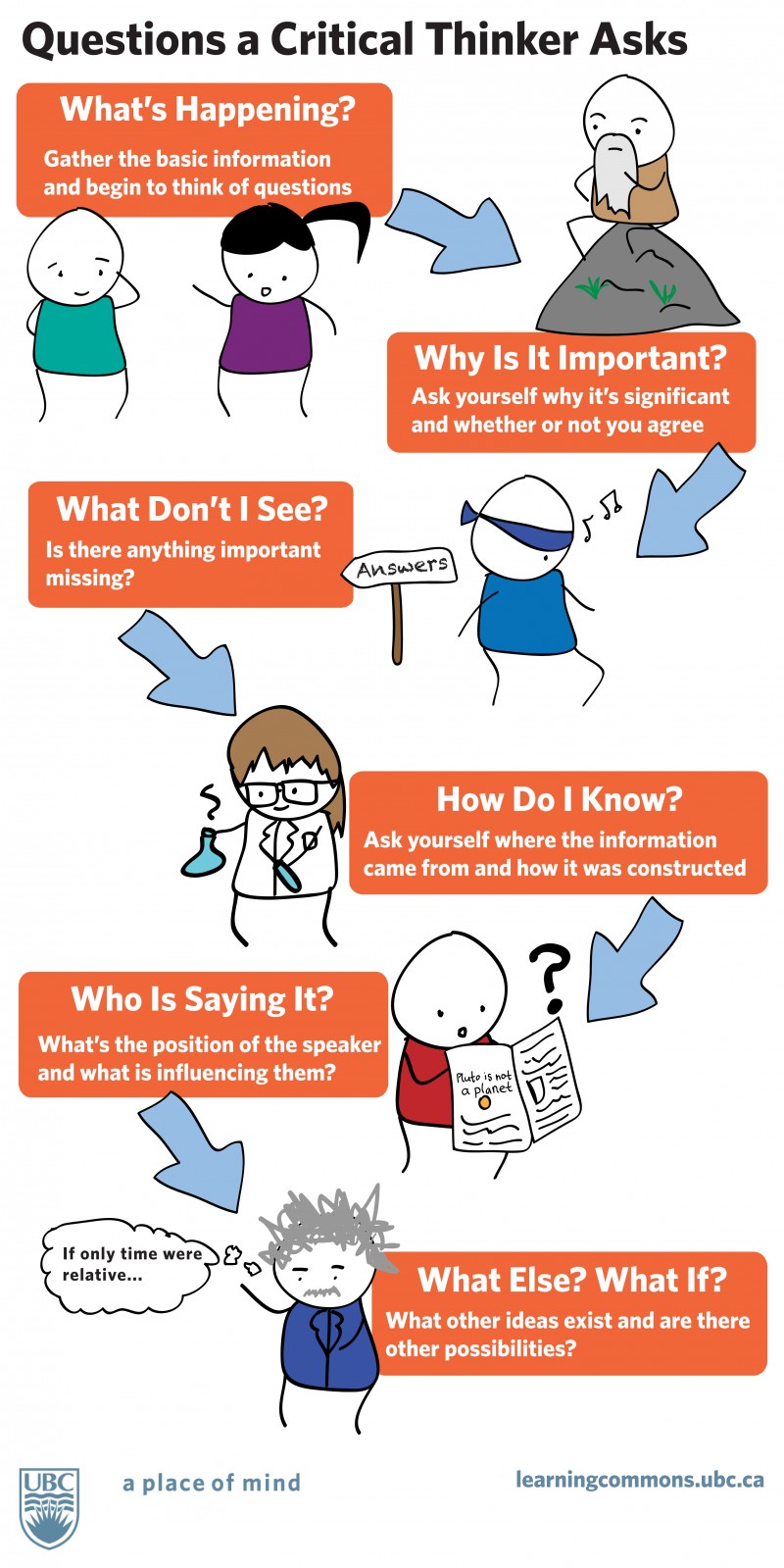
They key to critical thinking is the ability to pose challenging and provocative questions to yourself. To think critically is to delve deeper into those hidden layers of meaning and dissect the message in a comprehensive way. Of course, critical thinking is a very important skill mandated by the cognitive demands of a highly conceptual era.

For instance, living in an age where information overflow is the currency, it becomes imperative that students use their critical thinking abilities to sift through and assess the information they come across both online and in print. In this regard, the folks in UBC Learning Commons has this wonderful visual featuring 6 questions every critical thinker should be able to ask. These are the kind of questions students should learn to ask themselves anytime they are to evaluate a particular resource. I invite you to have a look and share with your students.

UBC Learning Commons has this excellent Pinterest board where you can access a wide variety of other similar visuals to use in class with students. Check it out.

critical thinking questions  Follow us on : Twitter, Facebook , Google plus, Pinterest .

Sunday, November 9, 2014

Interesting Poster Featuring 6 Presentation Skills You Should Know about

November 10, 2014
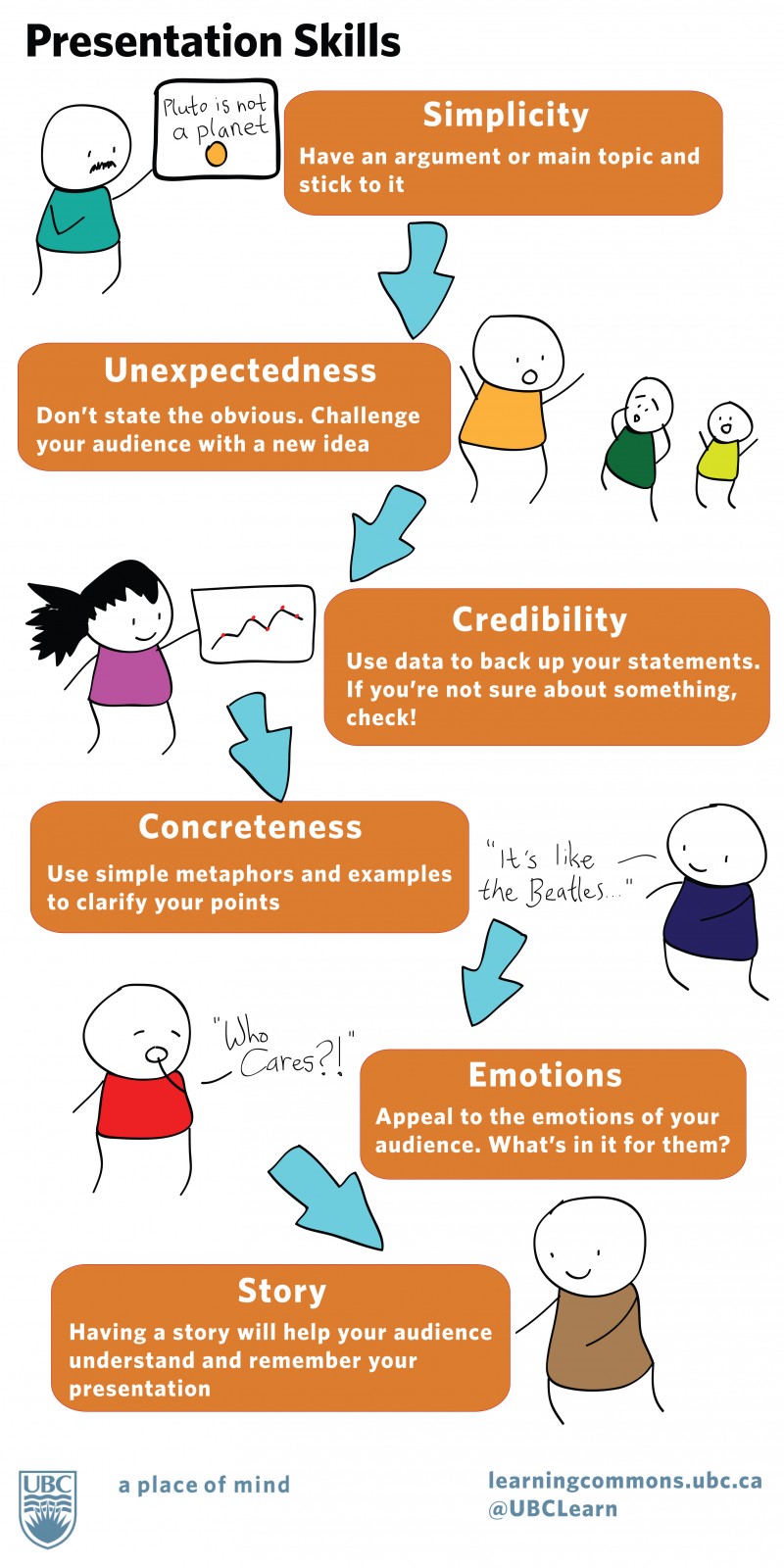
Creating and delivering successful presentations is a skill that requires some serious practice and learning. In the course of our work as educators and teachers, we are all likely to be in positions where we have to present in front of an audience. But do we really have what it takes to engage our audience and keep them focused? People can easily get distracted especially if your presentation is not intellectually and visually attractive.

University of British Columbia Learning Commons has this wonderful poster featuring some of the core presentation skills you need to keep in mind when preparing for your next presentation. They have also provided this excellent cheat sheet that you can download in PDF format. Have a look and share with us what you think of it. Enjoy


presentation skills  Follow us on : Twitter, Facebook , Google plus, Pinterest .

Tuesday, November 4, 2014

A Beautiful Classroom Poster on Essay Writing

November 5, 2014
Essay writing is a tedious task that demands a lot of thinking and rethinking. It is also a skill that can be developed through stages the first of which is reading. It is a truism that reading is a key to good writing but not the sole key for there are other factors that impact one's writing style such as practice, grammatical and syntactical knowledge, genre to mention a few. Generally speaking, essays have a common stylistic pattern that consists of introduction, body and conclusion. The development of each of these sections is regulated by a set of standardized conventions. For instance,  the introduction should be crafted in such a way that it sets the scene for what will be discussed in the main body of the essay. The body should contain multiple paragraphs cohesively related to each other. And the conclusion should sum up the core of the argument running through the essay.

A good and illustrative way to explain the steps to writing a good essay is through this analogy We Are Teachers made in this beautiful visual. The Bones of A Good Essay mimics essay components to body parts and provides some useful tips and pieces of advice on how to work on each part. I believe this could be a very good material to use with students in class especially that it is provided in a PDF format that you can download and print for free.

Click HERE to download the PDF format of this visual. Enjoy


Sunday, November 2, 2014

Tons of Great Free Downloadable Classroom Posters and Educational Infographics

November 2, 2014
Looking for some very good resources for educational infographics and classroom posters? We got you covered. The Pinterest board of our blog has a section dedicated entirely to visuals and interactives you can use in your classroom. We have over 300 beautiful infographics which are all education related. Besides that, we are also introducing you to another great resource from We Are Teachers that we have recently discovered. This page has tons of infographics and classroom posters that you can download and print for free. These materials cover a wide variety of educational topics including dyslexia, fluency, technology, and more. "Through these infographics, you can absorb information at a glance and expand your knowledge about diverse topics relevant to education."

The visuals featured in  this resource are arranged into four main categories: infographics, classroom posters, comic relief, teacher inspiration and classroom handouts. Browse through this collection and pick out the ones you like. To download any visual just click on it and then in the next page click on "download". Enjoy.


Friday, October 17, 2014

Awesome Poster Featuring 15 Online Netiquette Rules for Students

October 17, 2014
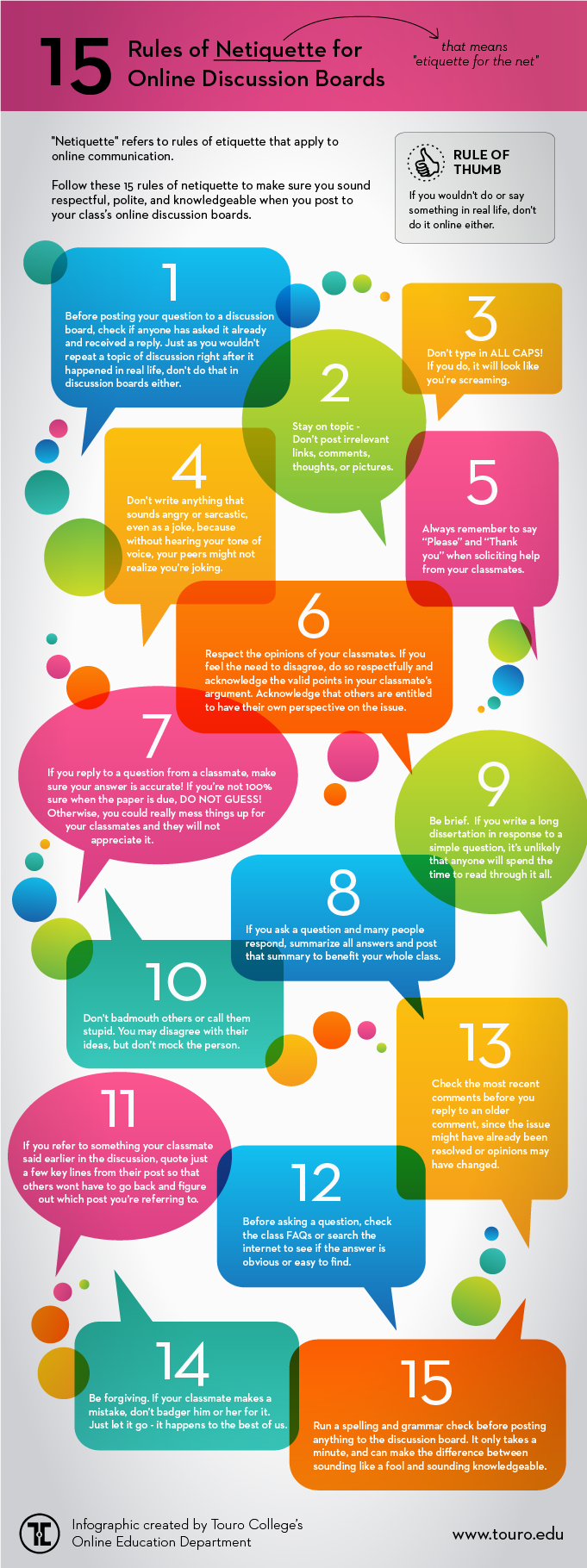
Here is a good visual encompassing some important netiquette rules for students to keep in mind while using the net. You might want to go through these rules with your students to make sure they understand them. Here is a quick round-up of these netiquette rules:

1- Before posting your question to a discussion board, check if anyone has asked it already and received a reply. Just as you wouldn't repeat a topic of discussion right after it happened in real life, don't do that in discussion boards either.
2-Stay on topic, don't post irrelevant links, comments, thoughts, or pictures.
3-Don't type in ALL CAPS! If you do, it will look like you're screaming.
4- Don't write anything that sounds angry or sarcastic, even as a joke, because without hearing your tone of voice, your peers might not realize you're joking.
5- Always remember to say "Please" and "Thank you" when soliciting help from your classmates.
6-Respect the opinions of your classmates. If you feel the need to disagree, do so respectfully and acknowledge the valid points in your classmate's argument. Acknowledge that others are entitled to have their own perspective on the issue.
7-If you reply to a question from a classmate, make sure your answer is accurate! If you're not 100% sure when the paper issue, DO NOT GUESS! Otherwise, you could really mess things up for your classmates and they will not appreciate it.
8- If you ask a question and many people respond summarize all answers and post that summary to benefit your whole class.
9- Be brief. If you write a long dissertation in response to a simple question, it's unlikely that anyone will spend the time to read through it all.
10-Don't badmouth others or call them stupid. You may disagree with their ideas, but don't mock the person.
11- If you refer to something your classmate said earlier in the discussion, quote just a few key lines from their post so that others won't have to go back and figure out which post you're referring to.
12-Before asking a question, check the class FAQs or research the Internet to see if the answer is obvious or easy to find.
13- Check the most recent comments before you reply to an older comment, since the issue might have already been resolved or opinions may have changed.
14- Be forgiving. If your classmate makes a mistake, don't badger him or her for it. Just let it go-it happens to the best of us.
15- Run a spelling and grammar check before posting anything to the discussion board. It only takes a minute, and can make the difference between sounding like a fool and sounding  knowledgeable.


team work
Source: Touro